
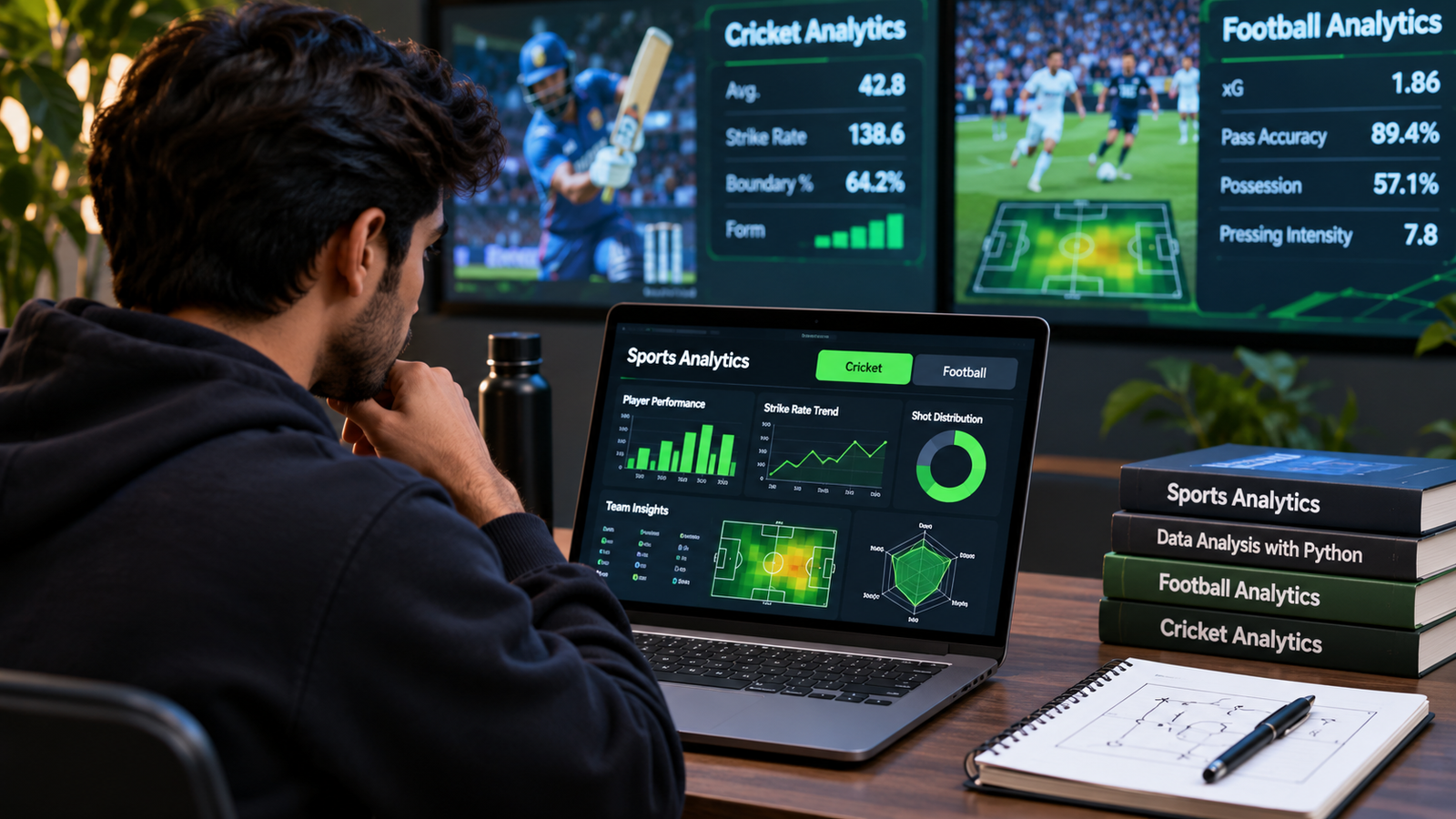
Introduction: Why Sports Analytics Is Becoming a Career Opportunity
Sports have always been driven by talent, strategy, preparation and performance. Today, data is becoming an equally important part of the game.
From cricket teams analysing batting and bowling performances to football clubs evaluating player movements and tactical decisions, sports organisations increasingly use data to understand what happens on the field.
This is where sports analytics comes in.
Sports analytics involves collecting, processing and analysing sports-related data to identify patterns, evaluate performance, support decisions and improve results.
For someone who loves sports and is interested in numbers, technology, research or problem-solving, sports analytics can offer an exciting career path.
You do not necessarily need to be a professional athlete or have played sports at a competitive level. What matters is developing the right combination of sports knowledge, analytical thinking and technical skills.
In this guide, we will explore everything you need to know about building a career in sports analytics.
1. What Is Sports Analytics?
Sports analytics is the application of data analysis, statistics and technology to understand and improve sporting performance.
It involves studying information such as:
Player performance and consistency
Batting and bowling statistics in cricket
Passing accuracy and player positioning in football
Team performance and tactical patterns
Match conditions and venue performance
Player fitness and workload
Opposition strengths and weaknesses
Player scouting and recruitment
Match predictions and win probability
For example, a cricket analyst might study a batter's performance against different types of bowling, while a football analyst might evaluate a midfielder's passing patterns and defensive contributions.
The objective is not simply to present statistics. It is to convert data into useful insights that help coaches, players, analysts and management make better decisions.
2. Why Do Sports Teams Need Data Analysts?
Modern sports involve thousands of decisions. Teams need reliable information to evaluate players, prepare strategies and understand performance.
Sports analytics helps organisations in several areas.
Player Performance Analysis
Analysts evaluate individual player performances using statistical measures and video analysis.
Examples include:
Batting strike rate and average
Bowling economy and wicket-taking ability
Passing accuracy
Expected goals (xG)
Defensive contributions
Player consistency
Opposition Analysis
Teams study opponents before important matches.
Analysts identify:
Opponent strengths and weaknesses
Tactical patterns
Player tendencies
Scoring opportunities
Defensive vulnerabilities
Scouting and Recruitment
Data helps organisations identify players who fit their requirements.
For example, a cricket franchise might compare players based on their performance against pace bowling, spin bowling, different match situations and venue conditions.
Strategy and Decision-Making
Analysts provide information that supports decisions related to:
Team selection
Playing combinations
Batting and bowling strategies
Substitutions
Match preparation
Auction and recruitment planning
Performance and Video Analysis
Combining video with performance data helps analysts understand why a particular result occurred, rather than simply looking at the final numbers.
3. Career Opportunities in Sports Analytics
Sports analytics is not limited to one job title. There are several career paths depending on your interests and skills.
1. Sports Data Analyst
A sports data analyst collects, cleans and analyses sports data to identify meaningful patterns.
Responsibilities:
Analyse player and team statistics
Prepare reports and dashboards
Identify performance trends
Build statistical comparisons
Communicate findings to stakeholders
Useful skills: Excel, SQL, Python, statistics and Power BI or Tableau.
2. Cricket Analyst
A cricket analyst studies batting, bowling, fielding and match-related data.
Responsibilities:
Analyse batter and bowler performance
Prepare opposition reports
Study venue and pitch trends
Evaluate player combinations
Support scouting and auction decisions
Develop match-related statistical models
Useful skills: Cricket knowledge, Excel, Python, SQL, data visualisation and statistical analysis.
3. Football Analyst
A football analyst evaluates team tactics, player performance and match events.
Responsibilities:
Analyse passing and possession patterns
Evaluate attacking and defensive performance
Study player positioning
Prepare opposition analysis
Work with event and tracking data
Support recruitment and scouting
Useful skills: Football knowledge, Python, Excel, SQL, video analysis and visualisation tools.
4. Performance Analyst
A performance analyst works closely with coaching and performance departments.
Responsibilities:
Evaluate individual and team performance
Analyse match footage
Prepare performance reports
Identify technical and tactical improvements
Present insights to coaches and players
5. Sports Data Scientist
A sports data scientist uses advanced statistical methods and machine learning to solve complex sports-related problems.
Responsibilities:
Develop predictive models
Build player evaluation systems
Create win probability models
Perform advanced statistical analysis
Develop simulations
Work with large datasets
Useful skills: Python, statistics, machine learning, SQL and data science.
6. Sports Research Analyst
A sports research analyst studies trends, competitions, players, teams and the sports business ecosystem.
Responsibilities:
Conduct sports research
Analyse industry trends
Prepare reports
Evaluate player and team performance
Support strategic decisions
7. Sports Business and Strategy Analyst
This role focuses on the commercial side of sports.
Responsibilities:
Analyse audience and fan engagement
Study sponsorship performance
Evaluate ticketing and revenue trends
Research market opportunities
Support business decisions
4. Technical Skills Required to Become a Sports Analyst
You do not need to master every tool on your first day. Start with the fundamentals and gradually develop your technical abilities.
Excel and Google Sheets
Excel is one of the most useful starting points for sports analytics.
Learn:
Data cleaning
Sorting and filtering
Pivot tables
Lookup functions
Conditional formatting
Charts and dashboards
Statistical formulas
SQL
SQL helps analysts retrieve and manage data stored in databases.
Important topics:
SELECT statements
WHERE conditions
GROUP BY
ORDER BY
JOIN operations
Aggregate functions
Subqueries
Window functions
Python
Python is widely used for sports data analysis and automation.
Important libraries include:
Pandas for data manipulation
NumPy for numerical operations
Matplotlib for visualisation
Seaborn for statistical charts
Scikit-learn for machine learning
Data Visualisation
Analysts must communicate their findings clearly.
Popular tools:
Tableau
Power BI
Looker Studio
Matplotlib
Seaborn
Statistics
Statistical knowledge helps analysts interpret data correctly.
Important concepts:
Mean, median and mode
Standard deviation
Correlation
Probability
Distributions
Regression
Hypothesis testing
Sampling and bias
Machine Learning
Machine learning can help identify patterns and build predictive models.
Relevant applications:
Match outcome prediction
Player performance forecasting
Player clustering
Win probability estimation
Player similarity analysis
Start with basic statistical methods before moving into advanced machine learning.
5. How Much Sports Knowledge Do You Need?
Technical skills alone are not enough.
A sports analyst must understand the game and know which questions are important.
For cricket, understand:
Batting and bowling fundamentals
Different match formats
Powerplay, middle overs and death overs
Batting positions
Bowling variations
Pitch and venue conditions
Fielding and match situations
Player roles and team combinations
For football, understand:
Formations and tactics
Possession and passing
Attacking and defensive phases
Player positioning
Pressing systems
Set pieces
Expected goals and expected assists
The more deeply you understand the sport, the better you can interpret its data.
6. Educational Qualifications: What Should You Study?
There is no single educational qualification that guarantees a career in sports analytics.
People from different academic backgrounds can enter this field.
Relevant backgrounds include:
Mathematics and Statistics
Computer Science
Data Science
Engineering
Sports Management
Physical Education
Economics
Business Analytics
A degree in a relevant discipline can be useful, but practical analytical ability, domain knowledge and project experience are also important.
If you come from a non-technical background, you can begin with Excel, statistics and basic data analysis before learning programming.
7. What Is the Salary of a Sports Analyst?
Sports analytics salaries vary significantly depending on the organisation, location, experience, technical skills and responsibilities.
The following are broad illustrative annual salary ranges for the Indian market, not guaranteed industry-wide figures:
Experience
Illustrative annual range
Entry-level / Intern
₹1.5–3.5 lakh
Junior Analyst
₹3–6 lakh
Experienced Analyst
₹6–12 lakh
Senior Analyst
₹12–20 lakh+
Specialist / Leadership Roles
Varies considerably
These figures are indicative estimates, not verified salary benchmarks. Actual internship stipends and job offers may be lower or higher.
Factors influencing salary include:
Programming and statistical skills
Experience with real sports datasets
Quality of portfolio projects
Sport-specific knowledge
Ability to communicate insights
Experience working with professional teams or organisations
Specialised roles involving data science, performance technology and advanced modelling may have different compensation structures.
8. Where Can You Work as a Sports Analyst?
Sports analytics professionals can explore opportunities across different parts of the sports industry.
Professional Sports Teams and Franchises
Examples include:
Cricket franchises
Football clubs
National and state teams
Domestic sports teams
Sports Federations and Organisations
These organisations may use analytics for performance evaluation, talent identification and strategic planning.
Sports Technology Companies
Sports technology companies work on:
Performance tracking
Video analysis
Sports data platforms
Athlete monitoring
Statistical products
Sports Media and Broadcasting
Analysts contribute to:
Match statistics
Data-driven storytelling
Broadcast graphics
Tactical analysis
Sports research
Sports Research and Consulting
Organisations may require analysts for scouting, recruitment, performance research and sports business intelligence.
Fantasy Sports and Sports Data Platforms
These businesses use statistical analysis, player performance information and predictive modelling in their products.
9. How to Build a Sports Analytics Portfolio
One of the best ways to demonstrate your skills is by building practical projects.
Employers and recruiters need to understand what you can actually do with data.
Here are some project ideas.
Project 1: IPL Batting Performance Dashboard
Analyse IPL batting data to identify:
Top run scorers
Strike rates
Batting averages
Boundary percentages
Performance across different seasons
Performance against different bowling types, where data is available
Tools: Excel, Python, Power BI or Tableau.
Project 2: Cricket Bowling Analysis
Study bowling performances using:
Economy rate
Bowling average
Strike rate
Wickets by innings phase
Performance against different batting styles
Tools: Python, Excel and visualisation libraries.
Project 3: Football Player Performance Dashboard
Evaluate football players using:
Goals and assists
Expected goals
Expected assists
Passing accuracy
Defensive actions
Minutes played
Tools: Python, SQL and Power BI.
Project 4: Match Win Probability Model
Build a model to estimate the probability of a team winning a match using available match information.
Possible variables include:
Current score
Overs completed
Wickets remaining
Required run rate
Target
Match format
Tools: Python, Pandas and Scikit-learn.
Project 5: Player Scouting Report
Compare multiple players based on their performance and suitability for a particular team role.
Include:
Performance metrics
Strengths and weaknesses
Consistency
Role suitability
Data limitations
Final recommendations
A good portfolio should explain the problem, dataset, methodology, findings and practical recommendations.
10. How to Get Your First Job in Sports Analytics
Getting your first opportunity can be challenging, especially without professional experience.
Follow this roadmap.
Step 1: Choose Your Sport
Start with a sport you understand or genuinely enjoy.
You can begin with cricket, football, basketball or another sport.
Step 2: Learn Data Fundamentals
Build a foundation in:
Excel
Statistics
Data cleaning
Data interpretation
Basic visualisation
Step 3: Learn Programming and Databases
Develop your skills in:
Python
SQL
Data manipulation
Data visualisation
Step 4: Work on Real Projects
Do not limit yourself to watching tutorials.
Work with publicly available sports datasets and develop practical analysis projects.
Step 5: Create a Portfolio
Publish your projects through platforms such as:
GitHub
Tableau Public
Power BI portfolio
Personal website
LinkedIn
Document your findings and explain your recommendations.
Step 6: Gain Practical Experience
Look for:
Sports analytics internships
Research opportunities
Freelance projects
Sports technology companies
Team analysis opportunities
Sports content and data research roles
Step 7: Prepare for Interviews
Be prepared to explain:
Your analytical projects
The metrics you selected
Why you selected those metrics
How you cleaned the data
What insights you discovered
How your findings can help a team
Your ability to explain your analysis is just as important as knowing the tools.
11. Is Sports Analytics a Good Career for Beginners?
Yes, sports analytics can be a suitable career direction for beginners who are willing to learn both sports and data analysis.
You do not need to know Python, SQL or machine learning before starting.
A beginner can follow this progression:
Beginner Level
Understand sports data
Learn Excel
Study basic statistics
Analyse simple player performances
Intermediate Level
Learn SQL
Develop Python skills
Build dashboards
Work on cricket or football projects
Advanced Level
Develop predictive models
Learn machine learning
Work on advanced scouting analysis
Build performance evaluation systems
Communicate insights to decision-makers
Consistency and practical experience are essential.
12. Challenges in a Sports Analytics Career
Like every specialised career, sports analytics has its challenges.
Limited Data Availability
Some sports datasets are expensive, restricted or incomplete.
Understanding the Game
A technically correct analysis may still be misleading if the analyst does not understand the sporting context.
Competition for Opportunities
Professional team positions can be limited, and candidates need to demonstrate practical ability.
Communicating Insights
Analysts must explain complex findings in simple language to coaches, players and management.
Data Quality
Incomplete, inconsistent or incorrectly recorded data can affect the accuracy of analysis.
Learning how to identify limitations and communicate uncertainty is an important professional skill.
13. The Future of Sports Analytics
The role of data in sports is continuing to evolve.
Several developments are creating new possibilities.
Artificial Intelligence: AI can assist with analysing large datasets, identifying patterns and automating certain research tasks.
Computer Vision: Video-based systems can help track player movements and generate performance information.
Predictive Analytics: Statistical models can support performance forecasting, recruitment and match preparation.
Wearable Technology: Athlete tracking devices can provide information about movement, workload and physical performance.
Real-Time Analytics: Teams and broadcasters can use live data to understand match situations and performance patterns.
These technologies are creating opportunities for people who can combine sports knowledge with data, technology and research.
14. How GrowSports Can Help You Start a Career in Sports Analytics
Learning sports analytics requires more than theoretical knowledge. You need practical experience with sports datasets, analytical tools and real-world problems.
GrowSports offers a Sports Analytics Masterclass designed to help learners develop sports analytics skills through structured learning and practical projects.
The learning areas include:
Introduction to sports analytics
Cricket data fundamentals
Key performance metrics
Excel for sports analytics
SQL for sports data
Python for sports analytics
Batting and bowling analysis
Venue and toss analysis
Scouting and auction analysis
Win probability modelling
Data visualisation
Tableau and Looker Studio
Introduction to AI in sports
Machine learning applications
Capstone projects
Portfolio and placement preparation
The programme also includes practical project work and an internship component as described in the programme structure. Internship and placement opportunities are subject to the programme's applicable eligibility and participation requirements.
Explore the programme:
https://growsports.in/sports-analytics
For programme details:
https://wa.link/bzfxnt
Frequently Asked Questions About a Career in Sports Analytics
Q1. Can I become a sports analyst without playing professional sports?
Yes. Professional playing experience is not compulsory for every sports analytics role. However, understanding the sport, its rules, strategies and performance metrics is important.
Q2. Is coding compulsory for sports analytics?
Not for every entry-level role. Excel and basic statistics are useful starting points. Python and SQL become increasingly valuable as you progress into more technical analytical work.
Q3. Which programming language is best for sports analytics?
Python is an excellent starting point because of its data analysis, visualisation and machine learning libraries. SQL is also important for working with databases.
Q4. Can a commerce or arts student enter sports analytics?
Yes. Students from commerce, arts and other non-technical backgrounds can enter the field by learning statistics, Excel, programming and sports-specific analysis.
Q5. What is the difference between a sports analyst and a data analyst?
A general data analyst works across different industries, while a sports analyst applies analytical methods specifically to sports-related questions, such as player performance, team strategy, scouting and match analysis.
Q6. How long does it take to learn sports analytics?
The time required depends on your starting knowledge, learning schedule and practical experience. A structured learning plan and consistent project work can help you build skills progressively.
Q7. Do sports analysts work only with cricket and football?
No. Sports analytics can be applied to basketball, tennis, hockey, kabaddi, athletics and many other sports.
Q8. What should I include in my sports analytics resume?
Include your technical skills, sports knowledge, projects, datasets used, dashboards, research reports, internship experience and measurable contributions.
Q9. Is sports analytics a good career in India?
It can be a promising specialised career for people interested in sports, data and technology. Opportunities exist across teams, sports technology companies, media, research and sports businesses. The number and availability of roles vary by sport and organisation.
Q10. What is the best way to get started?
Choose a sport, learn Excel and statistics, develop Python and SQL skills, build practical projects and create a portfolio that demonstrates your ability to turn sports data into useful insights.
Conclusion: Turn Your Passion for Sports into an Analytical Career
Sports analytics brings together two powerful interests: sports and data.
It offers opportunities to work on player performance, team strategy, scouting, research, technology and business decisions.
However, building a career requires more than passion. You need technical knowledge, an understanding of the game, practical project experience and the ability to communicate insights.
Start with the fundamentals, work with real sports data and keep building your portfolio.
The future of sports will increasingly involve data-driven decisions. Your journey into this industry can start with your next analysis project.
Learn Sports Analytics with GrowSports.
Explore the Sports Analytics Masterclass: https://growsports.in/sports-analytics
WhatsApp for course details: https://wa.link/bzfxnt
LEARN WITH GROWSPORTS
Build your sports analytics skills.
Take your understanding of sports data to the next level with practical learning and expert mentorship.
Explore the Masterclass →